
What “learning piano” actually consists of
Piano is not one skill. It is five, learned at the same time, and treating it as one is the single most common reason beginners stall. PianEd separates them so each can move at its own pace, then keeps reconnecting them to music you can actually play.
1. Where the notes are
The black keys repeat in groups of two and three. That single pattern locates every white key without memorising 88 positions. It is the first thing PianEd teaches, and it is a short lesson.
2. How the hands move
Fingers are numbered 1 to 5 from each thumb. Consistent fingering is what lets a passage become automatic; inconsistent fingering is what keeps it permanently difficult.
3. How rhythm works
Counting out loud at a slow tempo fixes more problems than playing fast ever will. Every piece can be slowed down without the pitch or the phrasing going strange.
4. How music is written
The stave, note values, key signatures and the rest — taught next to the pieces that use them, so each idea arrives with a reason to care about it.
5. Turning it into a piece
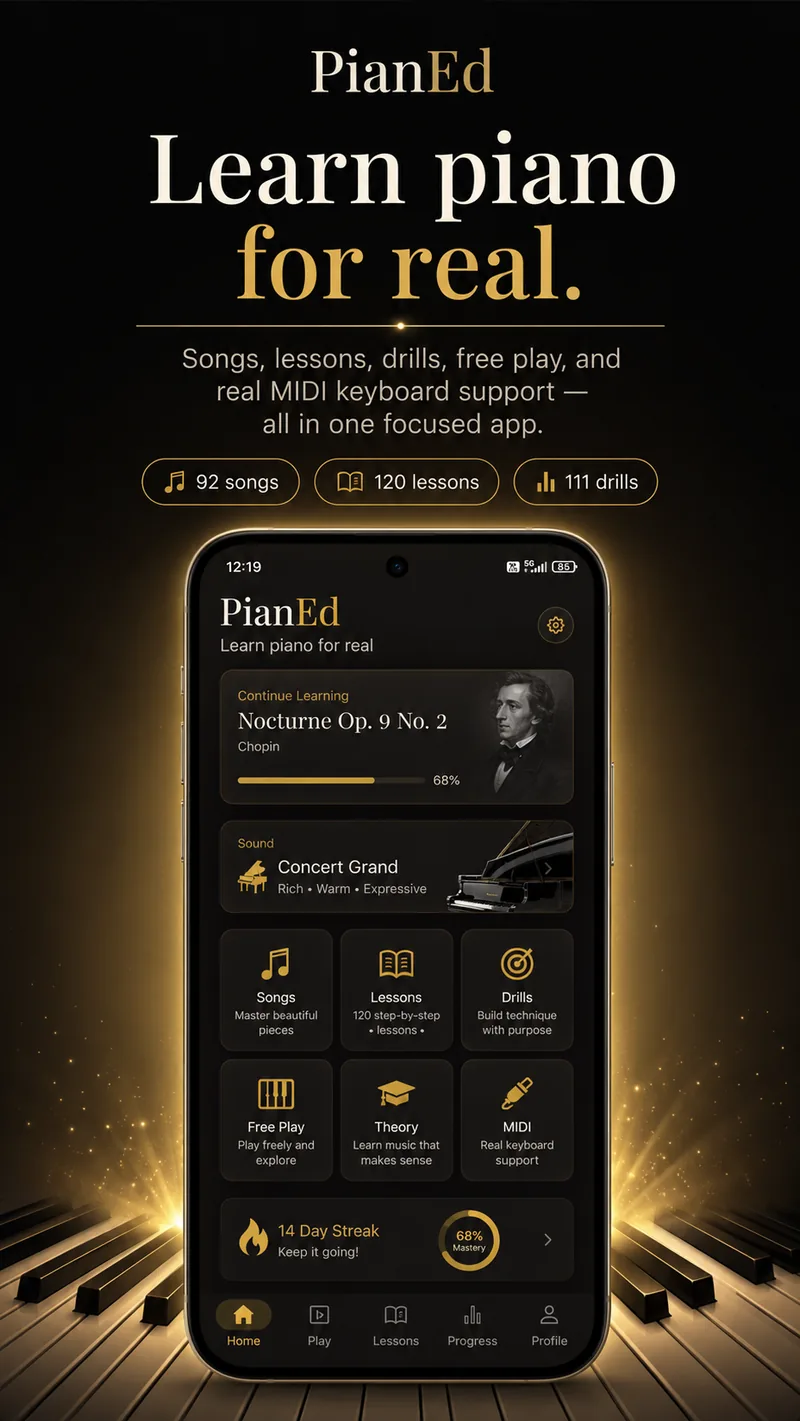
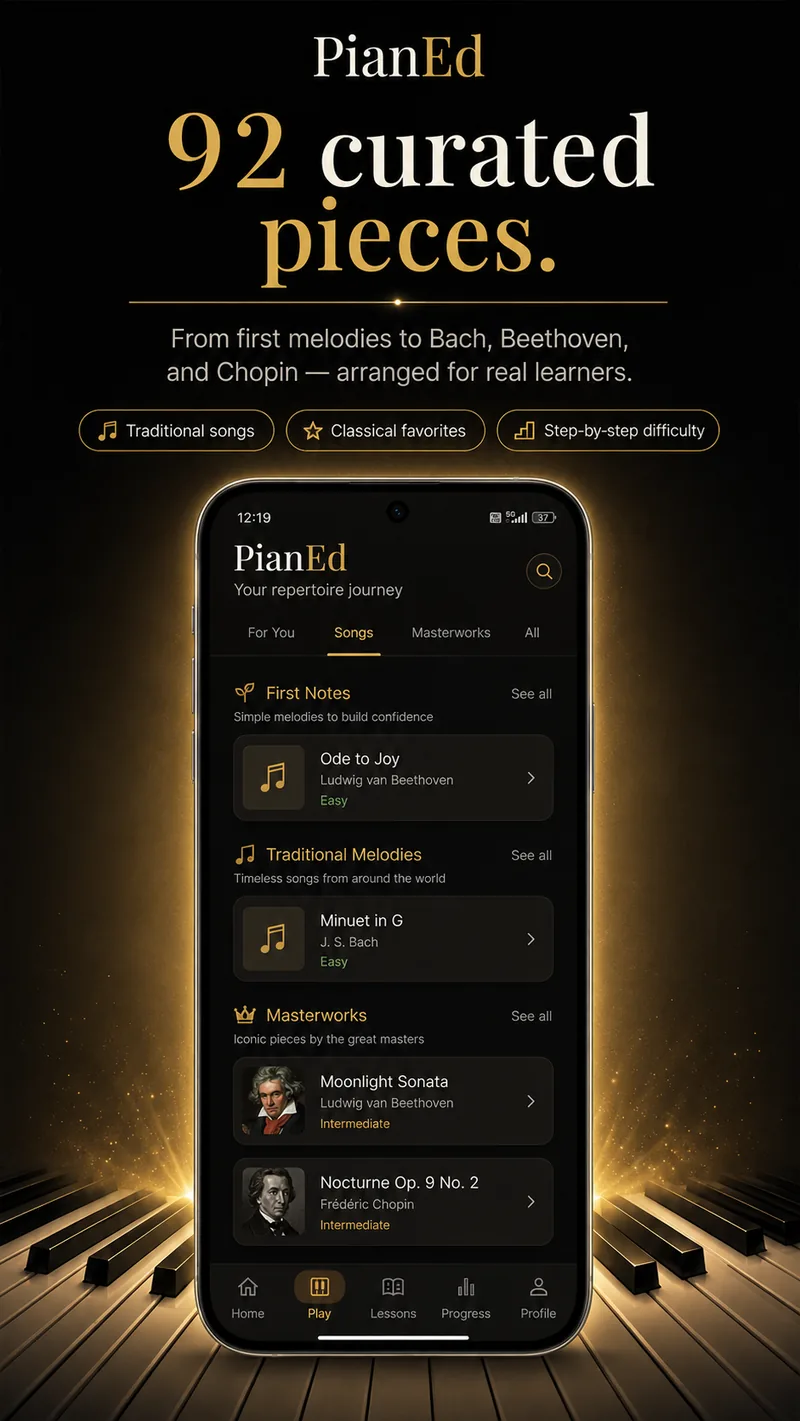
92 arrangements, from first melodies to Bach, Beethoven and Chopin, written for learners rather than dropped in at concert difficulty.
And the habit
Fifteen minutes most days beats two hours once a week, every time. The 60-second Daily Key Rush exists mainly to protect the streak on the days you would otherwise skip.
Six levels, in a teacher’s order
Level 1 — First Notes — is free forever: the keyboard, posture, hand shape, middle C, the stave and your first one-hand songs. It is a complete beginner course on its own, not a trial that expires.
From there: Hands Together (five-finger positions, intervals, both hands at once), Scales & Chords (thumb-under, major scales, triads), Keys & Colour (minor keys, the circle of fifths, inversions), Expression (sevenths, syncopation, pedalling, ii–V–I) and Mastery (two-voice independence, polyrhythm, jazz voicings, composing).
Each level runs across all three paths at once, so you are never reading theory that is six months ahead of what your hands can do.
Why an app can teach this, and where it stops
Being honest about the limits is more useful than pretending there are none.
| Skill | Can PianEd teach it? | Notes |
|---|---|---|
| Keyboard geography, note names | Fully | Identical on a screen and on real keys |
| Reading the stave | Fully | 120 lessons, each ending in a quiz |
| Rhythm and counting | Fully | Timing judged as Perfect, Good or OK |
| Music theory | Fully | Through to cadences and the circle of fifths |
| Fingering habits | Fully | Standard fingering on all 111 drills |
| Touch, weight and dynamics | Partly | Needs velocity-sensitive keys — connect a MIDI keyboard |
| Full-hand position across octaves | Partly | A phone screen is narrower than 88 keys |
| Advanced two-hand repertoire | Eventually needs hardware | Learn everything else first, then buy |
Your first week, concretely
Day 1 — the shape of the keyboard
Find the groups of two and three black keys. Find every C. Play a five-note melody — a short first session, and you have played music.
Days 2–3 — finger numbers and position
Right hand in C position, one finger per key. The first technique drills, with the fingering shown on screen.
Days 4–5 — reading and rhythm
Where middle C sits on the stave, and what a crotchet is worth. Two short theory lessons and their quizzes.
Days 6–7 — a real piece
A complete short piece in wait mode, then again at full tempo. Then the Daily Key Rush, to see the habit start.
Questions
Frequently asked
Can I really learn piano on a phone?
For the foundations, yes. Keyboard geography, note reading, rhythm, theory, fingering habits and simple melodies all transfer directly to real keys. What a touchscreen cannot teach is key weight and the feel of dynamics, which is where a MIDI keyboard or digital piano becomes worth buying — usually after a few weeks, not on day one.
How long before I can play a song?
Everyone progresses at a different pace. Wait mode holds on each note until you find it, so a piece is playable well before it is fluent — and playing it at full tempo, from memory and with both hands, is the part that takes real practice.
Do I need to read music first?
No. PianEd starts before notation, with finding middle C and shaping your hand. Reading is introduced gradually alongside pieces you can already play by ear and by shape.
Is Level 1 really free forever?
Yes. It does not expire, does not ask for a card and does not degrade. A PianEd Pro subscription unlocks Levels 2 to 6.
How much practice does this take?
That is your choice. Short, consistent practice is generally more useful than occasional long sessions, and the app is built around that assumption rather than around a target you have to hit.
Keep reading
Your first lesson is free, and so is the fiftieth
Level 1 covers all three paths and never expires. No account needed to begin.
Android 7.0 or later · Level 1 free forever · No card required